

If your dentist has recommended a root canal, there’s no need to panic. Modern root canal therapy is a predictable, routine treatment designed to relieve pain and preserve a natural tooth when its inner tissues are compromised. In many cases, choosing root canal therapy allows you to keep your tooth rather than resorting to extraction, which helps maintain chewing function and facial structure.
At the office of Dentistry of Sugar Land, we pair contemporary techniques with patient-focused care to make the experience as comfortable and efficient as possible. Our team prioritizes gentle treatment, clear communication, and long-term outcomes so you feel confident about the path forward for your oral health.
Retaining your natural tooth whenever feasible is generally the best outcome for oral health. A tooth that has been treated with root canal therapy can continue to function for many years—often for the rest of a patient’s life—when it is properly restored and cared for. Saving a tooth prevents the need for more extensive restorative work that can affect adjacent teeth.
When a tooth is removed, neighboring teeth can shift, bite relationships can change, and the bone that once supported the tooth can begin to resorb. Root canal therapy helps preserve the natural root structure and supports the integrity of your bite and smile. With contemporary materials and crowns, a treated tooth can be durable and esthetically pleasing.
Success rates for modern root canal procedures are high when performed with careful technique and followed by timely restoration. For many people, a treated tooth enables normal eating, speaking, and smiling without the compromises that often accompany missing teeth.

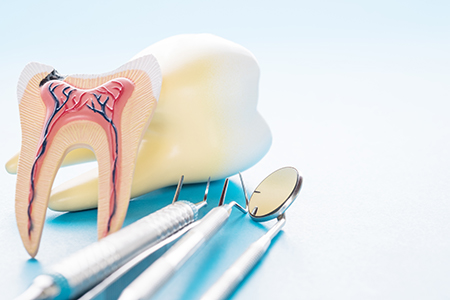
Inside each tooth sits the dental pulp — a small bundle of nerves, blood vessels, and connective tissue that supports initial growth and provides sensation. When decay, trauma, or repeated dental work reaches this inner space, the pulp can become inflamed or infected. Because the pulp is enclosed in rigid tooth structure, inflammation often causes persistent pain or heightened sensitivity.
Symptoms vary, from lingering sensitivity to hot or cold to sharp pain when biting. In some cases a tooth may darken, develop a visible crack, or show localized gum swelling. Occasionally an infection around the root tip is first identified on a routine X-ray before symptoms appear, which is why regular exams and radiographs remain important.
Not every ache requires root canal therapy, but when the pulp is irreversibly damaged or has died, root canal treatment becomes the preferred option to remove infection, preserve the tooth, and prevent further spread of disease to surrounding bone and tissues.
Common signs that may indicate the need for root canal treatment include:
Pain that does not subside or that wakes you at night can be a signal that the inner tissues of the tooth are distressed. While many tooth pains have multiple causes, persistent pain that interferes with sleep or daily activities should be evaluated promptly.
Heightened or prolonged sensitivity to hot and cold that remains after the stimulus is removed may suggest that the pulp is inflamed or damaged and unable to recover on its own.
Sharp pain when chewing or tenderness to light touch can indicate pulpal involvement or an infection that is placing pressure on surrounding tissues.
Color changes can occur after an injury or when the blood supply to the tooth is disrupted. A darkened tooth can be a sign of internal changes that warrant evaluation.
Physical damage to a tooth can expose or injure the pulp even when the outer enamel appears largely intact. Cracks can allow bacteria to penetrate and lead to infection.
Gum swelling, a pustule, or the presence of fluid drainage (an abscess) are signs that an infection may be present and that professional care is needed.
Infection and associated bone loss can make a tooth feel mobile. Treating the source of infection often stabilizes the area and supports healing.

When signs point to pulpal damage or infection, timely diagnosis and treatment reduce the risk of complications. An untreated tooth infection can expand into surrounding bone, cause persistent pain, and occasionally contribute to more widespread health concerns. Early intervention helps limit damage and simplifies treatment.
Some teeth that need root canal therapy do not present with obvious symptoms and are first detected during routine exams or on radiographs. Regular dental visits make it possible to catch these issues early, when treatment is less complex and outcomes are more predictable.
Delaying care can increase the likelihood of needing additional procedures, such as surgical approaches or extraction followed by replacement. For optimal results, it’s best to follow through with recommended treatment once a definitive diagnosis is made.
Root canal therapy today uses refined instruments and techniques that make the procedure comfortable and efficient. Most treatments are performed under local anesthesia so you won’t feel pain during the procedure. For patients with significant anxiety, options for sedation are available to help create a calm experience.
Treatment typically involves accessing the inner chamber of the tooth, gently removing the infected or damaged pulp, and cleaning and shaping the root canal spaces. These spaces are then filled with a biocompatible material to seal them against reinfection. The work may be completed in one visit or staged over two or more appointments depending on the complexity, anatomy, and presence of active infection.
Following root canal therapy, the tooth is usually restored with a durable filling and frequently crowned to protect it from fracture and restore full function. Your dentist will explain the recommended restoration plan tailored to the tooth’s condition and your overall dental needs.
Recovery from a root canal is generally straightforward. You may experience mild soreness or sensitivity for a few days as surrounding tissues heal. Over-the-counter pain relievers usually manage this discomfort, and your dentist can advise or prescribe medication if needed.
While healing is taking place, protecting the treated tooth is important. A temporary filling may be placed initially, but a permanent restoration—often a crown—will be recommended to restore strength and prevent fracture. Completing the restorative phase in a timely manner helps ensure the longevity of the treatment.
Numbness from local anesthesia can last an hour or two. Avoid chewing or using the treated side until normal sensation returns to prevent accidental biting of soft tissues.
Some soreness near the treated tooth is normal and tends to improve over several days. If pain increases or if new symptoms appear, contact your dental team for guidance.
If an antibiotic is prescribed to address an active infection, it’s important to complete the full course as directed to support healing.
Teeth that have had root canal therapy can be more brittle until a permanent crown or restoration is placed. Avoid hard or sticky foods on the treated side when possible.
Brushing and flossing around the treated tooth helps maintain gum health and prevents new issues. Good home care, combined with routine dental visits, supports long-term success.
Discuss timing for a crown or other permanent restoration with your dentist. Completing this step will restore full chewing function and protect the tooth from future damage.
With appropriate treatment and ongoing care, a tooth restored after root canal therapy can remain functional for many years. Our approach focuses on predictable outcomes and patient comfort at every stage of treatment.
If you have questions about root canal therapy or think you may need an evaluation, please contact us for more information and to schedule an appointment.


A root canal procedure is the best way to save a tooth that has been damaged by decay or injury and preserve your natural smile. The alternative is an extraction and treatment to replace the tooth. While at times a tooth is non-restorable and an extraction is the only option, when possible, it’s best to try and save your natural tooth. With proper care, a tooth with root canal therapy can serve your smile well for many years to come.
Despite lingering myths from before the age of modern dental anesthesia and technology, having a root canal procedure today is as routine and comfortable as visiting the dentist for a filling. While the procedure is performed under local anesthesia with your tooth completely numbed, we can also discuss options in dental sedation.
Whether the symptoms of a dental infection subside after a course of antibiotics, a draining abscess provides you with some temporary pain relief, or a tooth with radiographic evidence of pathology has not yet developed symptoms, it’s essential, before an infection worsens or occurs, to have a root canal procedure performed. In this way, the tooth can be disinfected, filled, and sealed to protect your health and avoid further problems.
If you have sustained a dental injury, have a toothache, jaw pain, swelling, or are experiencing any other unusual and uncomfortable oral symptoms, contact our office immediately for care. Dental problems that have not been evaluated and treated can significantly worsen, producing more severe damage and consequences for the involved teeth, your oral health, and even your overall wellbeing. Once you get in touch with our office, our friendly and compassionate office team will get you in for care at your earliest convenience.
While some root canal procedures can be completed in one visit, others may involve 2 or 3 appointments. How long it takes depends on various factors, including active infection, the number of canals in the tooth, and the tooth’s location or anatomy.
With a success rate that exceeds 95%, root canal therapy remains the most effective procedure to save a tooth in which the inner vital tissues have been damaged. However, as with all healthcare procedures, there are a small percentage of cases where the teeth become symptomatic a second time. The good news is that many of these teeth can still be saved with root canal retreatment or a minor surgical procedure known as an apicoectomy.
The best ways to maintain a tooth with root canal therapy are to get the proper restoration required to rebuild and protect the tooth, maintain proper oral hygiene, and schedule appointments for routine dental checkups and care.
Saving a tooth with root canal therapy is a wise investment that, in the long run, is typically less costly and invasive than having the tooth extracted and replaced with a fixed bridge or implant. As far as the exact cost of care, it can vary depending on which tooth is being treated. Many dental insurance plans provide coverage for root canal therapy. At the office of Dentistry of Sugar Land, we do our best to optimize your dental benefits and minimize your out-of-pocket expenses. Our staff will answer all your questions about the cost of care and discuss all your payment options.
At the office of Dentistry of Sugar Land, we use the latest technology and most effective methods of care to provide precise and gentle care. Our reputation for excellence is based upon a consistent record of achieving successful treatment outcomes while providing prompt, stress-free, and convenient treatment for every type of dental need.
Root canal therapy is a dental procedure that removes infected or irreversibly damaged pulp from inside a tooth and seals the space to prevent reinfection. The goal of the treatment is to relieve pain, eradicate infection, and preserve the natural tooth rather than resorting to extraction. In many cases a treated tooth can continue to function normally once it is properly restored.
At the office of Dentistry of Sugar Land we emphasize conservative care that maintains chewing function and supports overall oral health. Modern techniques and materials make the procedure predictable and comfortable for most patients. Your dentist will explain the diagnosis and why root canal therapy is the best option for that particular tooth.
Common warning signs include ongoing, hard-to-ignore tooth pain, heightened or lingering sensitivity to hot or cold, and sharp pain when biting. A tooth that has darkened in color, shows localized gum swelling, or develops a pimple-like bump (sinus tract) near the gumline may also signal pulp damage or infection. Some teeth show no obvious symptoms and are first detected as problems on routine X-rays.
Because symptoms can overlap with other dental issues, a clinical exam and radiographs are necessary to determine whether the pulp is inflamed or infected. Prompt evaluation helps avoid progression of infection and increases the likelihood of a straightforward outcome. If you notice persistent or worsening signs, contact your dental team for an assessment.
After numbing the area with local anesthesia, the dentist creates a small access opening in the tooth to reach the pulp chamber and root canals. The inflamed or infected tissue is gently removed, the canal spaces are cleaned and shaped with specialized instruments, and the canals are disinfected to reduce the risk of persistent infection. Once prepared, the canals are filled with a biocompatible material and sealed to prevent bacterial re-entry.
Depending on the complexity and the presence of active infection, treatment may be completed in a single visit or staged over two appointments. A temporary filling may be placed initially, followed by a permanent restoration—often a crown—to restore strength and function. Your dentist will review the specific steps for your tooth and answer questions before beginning treatment.
Most patients do not feel pain during a root canal because the tooth and surrounding tissues are numb from local anesthesia. The goal is to remove the source of pain—the inflamed or infected pulp—so the procedure often provides significant relief. For especially anxious patients or complex cases, additional sedation options may be discussed to improve comfort.
Mild soreness or tenderness in the treated area is common for a few days as surrounding tissues heal and can usually be managed with over-the-counter pain relievers unless your dentist prescribes otherwise. If discomfort increases after the first few days or new symptoms develop, contact your dental team for guidance. Timely placement of the final restoration also helps minimize sensitivity and protect the tooth from fracture.
For patients who experience dental anxiety, a range of sedation options can make treatment more comfortable and reduce stress during the procedure. Local anesthesia is always used to prevent pain, and your dentist may offer nitrous oxide (laughing gas) or oral sedatives to promote relaxation for routine cases. These options are safe when administered by trained professionals and allow many patients to complete treatment with a calm, manageable experience.
In some practices, deeper forms of sedation are available and may be recommended for longer or more complex procedures, or for patients with extreme anxiety. Your dentist will evaluate your medical history, anxiety level, and treatment needs to recommend the most appropriate approach. Pre-appointment instructions and clear post-sedation guidance help ensure a safe and comfortable visit.
When the pulp is irreversibly damaged, root canal therapy is the standard treatment to save the tooth; however, alternatives do exist depending on the situation. Extraction removes the problematic tooth entirely and may be followed by options to replace the missing tooth, such as a dental implant, bridge, or partial denture to restore function and appearance. These replacement paths introduce additional procedures and considerations related to adjacent teeth, bone health, and long-term maintenance.
For some teeth with limited damage, monitoring or less invasive treatments may be viable if the pulp has the potential to recover, but this requires careful clinical evaluation and close follow-up. Your dentist will discuss the expected outcomes, benefits, and limitations of each option so you can make an informed decision aligned with your oral health goals. Timely diagnosis helps preserve more conservative choices whenever possible.
Root canal therapy has a high success rate, but like any medical procedure it carries some risks and potential complications. These can include persistent infection if bacteria remain in a complex canal system, fracture of a tooth that lacks timely restoration, or treatment challenges related to unusual canal anatomy. Occasionally, postoperative discomfort or swelling may occur and usually responds to appropriate care.
If symptoms persist or recur, retreatment or surgical procedures such as an apicoectomy may be necessary to address remaining infection or anatomical issues. Good communication with your dentist, completion of the recommended restoration (for example, a crown), and adherence to follow-up visits reduce the likelihood of complications. Your dentist will explain signs to watch for and how complications would be managed if they arise.
After treatment it is important to protect the tooth until a permanent restoration is placed, as teeth that have had root canal therapy can be more brittle and susceptible to fracture. Follow any temporary care instructions provided, avoid chewing on hard or sticky foods on the treated side, and resume gentle brushing and flossing to maintain gum health. If antibiotics or pain medications are prescribed, take them exactly as directed to support healing.
Schedule and complete the recommended permanent restoration—often a crown—to restore full function and seal the tooth against future breakdown. Keep routine dental appointments for exams and cleanings so your dentist can monitor the treated tooth over time. Prompt attention to new symptoms helps preserve long-term success.
When properly treated and restored, a tooth that has undergone root canal therapy can remain functional for many years and, in many cases, for the rest of a patient's life. Longevity depends on factors such as the quality of the initial treatment, the tooth's structural integrity, the type of final restoration, and the patient's oral hygiene and overall health. Teeth that receive timely crowns or appropriate restorations are less likely to fracture and typically have better long-term outcomes.
Regular dental care, including professional checkups and good home hygiene, helps identify problems early and extend the life of the restored tooth. If a treated tooth develops new symptoms or shows signs of breakdown, retreatment or surgical options may be considered to preserve it. Your dentist will discuss realistic expectations and a maintenance plan tailored to your needs.
If you are experiencing persistent tooth pain, swelling, or other symptoms that suggest pulpal damage or infection, contact our office to arrange an evaluation as soon as possible. Prompt assessment allows your dentist to diagnose the problem with a clinical exam and appropriate imaging, determine whether root canal therapy is indicated, and recommend a treatment plan that addresses both symptoms and long-term oral health.
Dentistry of Sugar Land strives to respond quickly to urgent dental needs and will explain next steps, pre-appointment instructions, and what to expect during the visit. If symptoms are severe or accompanied by systemic signs such as fever or significant swelling, seek immediate care and notify the dental team so they can prioritize your appointment and coordinate appropriate treatment.
Ready to schedule your next dental appointment or have questions about our services?
Contacting Dentistry of Sugar Land is easy! Our friendly staff is available to assist you with scheduling appointments, answering inquiries about treatment options, and addressing any concerns you may have. Whether you prefer to give us a call, send us an email, or fill out our convenient online contact form, we're here to help. Don't wait to take the first step towards achieving the smile of your dreams – reach out to us today and discover the difference personalized dental care can make.
